For anyone who has attended CES across multiple decades, the 2026 event landed with a familiar hum and a different kind of gravity. The show has always been a mirror of consumer technology in motion. What changed this year was its posture. CES felt less like a showcase of isolated breakthroughs and more like a systems-level conversation about how intelligence, interfaces, and infrastructure are settling into everyday life.
This matters for marketers because CES continues to function as an early warning system. It reveals where behaviors will shift before dashboards catch up, where consumer expectations are being quietly reset, and where old ideas are being refurbished—sometimes with more consequence than entirely new ones.
Hardware Still Dominates
Even with all the focus on AI, platforms, and systems, the electronics layer still matters. Hardware remains the substrate upon which intelligence, interfaces, and experiences are built, and the pace of innovation at that level continues to shape what is possible.
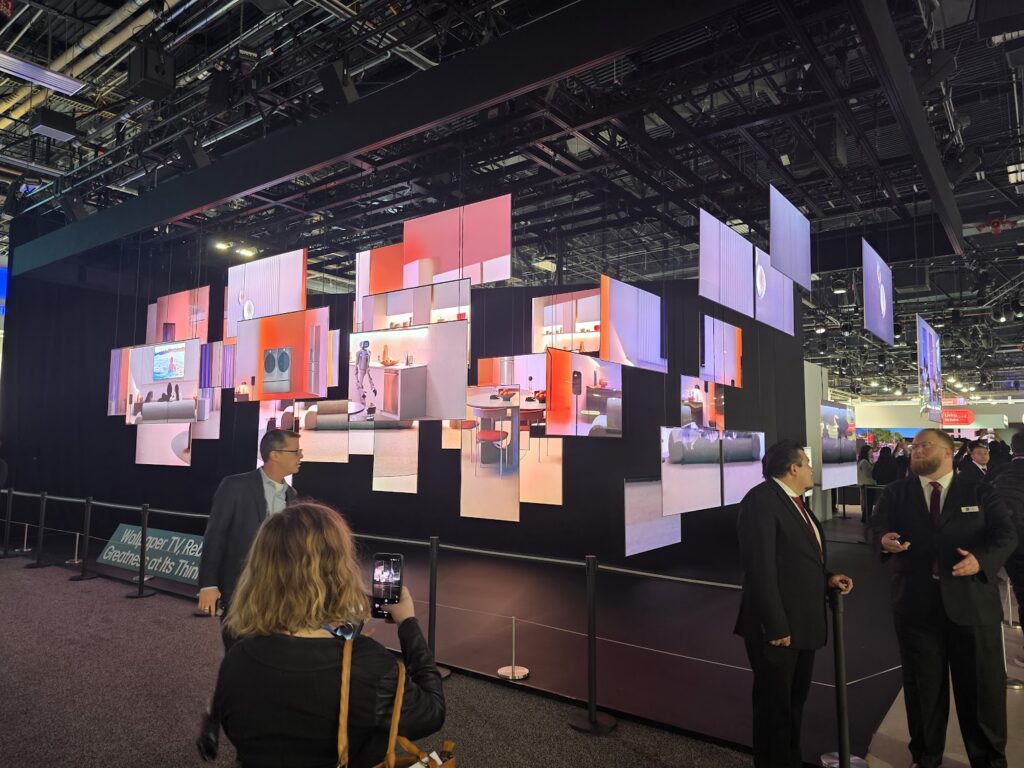
Screens are everywhere. But the more important shift is that intelligence is now ambient. Interfaces are dissolving into environments—homes, vehicles, workplaces, retail spaces—where interaction is increasingly implicit rather than explicit.
This evolution reframes the marketing conversation. When technology becomes background infrastructure, brand engagement is less about interruption and more about usefulness, timing, and context. The implications are structural, not tactical.
Old Ideas Return with Teeth
One of the more interesting patterns at CES 2026 was the resurfacing of familiar ideas that are now viable because the underlying constraints have changed.
Personalization, for example, has been around for a while. What’s new is the continuous signal flow now available through sensors, wearables, commerce systems, and media exposure. What used to be segmentation is becoming orchestration.
Similarly, automation has long promised efficiency. CES showed the move from rule-based automation to agentic systems—models that can observe, decide, and act with limited human intervention. That shift raises new questions about governance, incentives, and accountability, especially in media and marketing environments where optimization goals can conflict.
Mobility as a Computing Problem
Automotive and mobility have been CES staples for years, but 2026 clarified that systems are as important as vehicles. Cars, drones, industrial vehicles, and emerging air-mobility platforms are all being built from the same underlying components: computers, sensors, energy storage, software, and intelligence.
The most revealing aspect of mobility at CES was the modularization of innovation. Suppliers, startups, and platform builders are shaping the future of movement as much as traditional manufacturers. That democratization mirrors what happened in media and software years earlier.
For marketers, the lesson is indirect but important: when categories become platforms, brand experiences fragment across ecosystems. Control gives way to participation.
Makers, Edges, and Cultural Signals
The maker presence at CES continues to be a quiet counterbalance to the scale of the main floor. Individual builders and small teams, empowered by accessible computing, prototyping tools, and open-source frameworks, are experimenting at speeds large organizations cannot match.
From a marketing lens, makers matter less as competitors and more as signal carriers. They often surface emergent behaviors before they are commercialized. They test use cases before they are named. CES remains one of the few places where those edge experiments are visible in aggregate.
Media, Marketing, and the Center of Gravity
CES 2026 was also unmistakably a stage for marketing systems. Platforms, media owners, and agency networks used the moment to articulate end-to-end visions, often anchored in AI-enabled planning, activation, and measurement.
The scale of these announcements was deliberate. The industry is negotiating where authority will sit in an AI-mediated ecosystem: who designs the systems, who governs them, and whose incentives they ultimately serve.
What was notable was the urgency. Fragmentation remains unresolved. Measurement remains uneven. Walled environments persist. Agentic buying models raise the stakes further by compressing decision cycles and obscuring causality.
Creators as Infrastructure
Another clear shift was the normalization of creators as a structural layer of the media ecosystem rather than an add-on. CES reflected a more mature understanding of:
• Large creators operating as scaled distribution and brand engines
• Smaller creators functioning as trust-based community connectors
• Creator content feeding both narrative brand building and measurable outcomes
In an increasingly automated environment, creators represent a human interface that’s contextual, adaptive, and culturally fluent.
What This Validates for Quigley-Simpson as An Agency for the Future
From a Quigley-Simpson perspective, CES 2026 reinforced the direction we are already pursuing.
The value was not in chasing announcements, but in pressure-testing reality: meeting vendors, understanding how systems actually operate, and separating durable capability from marketing theater. CES remains most useful when approached as a learning environment rather than a shopping floor.
This is where our continued investment in an open, modular operating approach matters. Intelligence, identity, creative, media, and measurement are converging—but not neatly. Flexibility, interoperability, and disciplined experimentation are advantages, not compromises.
CES offered validation that progress is cumulative, iterative, and system-driven.
Closing Observation
CES 2026 felt optimistic without being naïve. The show reflected an industry moving from fascination with possibility to responsibility for outcomes.
For marketers, the task is to design systems that can adapt as intelligence becomes embedded everywhere. CES continues to matter because it surfaces those shifts early, in public, and at scale.
And yes, it remains exhausting.